“Our election was hijacked. There is no question. Congress has a duty to #ProtectOurDemocracy & #FollowTheFacts.”
— Nancy Pelosi, announcing her plans four years in advanceFaster, please.
A Glorious Future Approaches!
You know what this means:

Service Elf
Pet peeve: romanizations from the Japanese creator that don’t match their own text. For instance, the heroine of Cop Craft is named ティラナ, which is pronounced Tilana or Tirana, and that’s how everyone in the anime cast says it. But in the color art supplied with book one, it was written “Tilarna”, which makes that The Official Name.
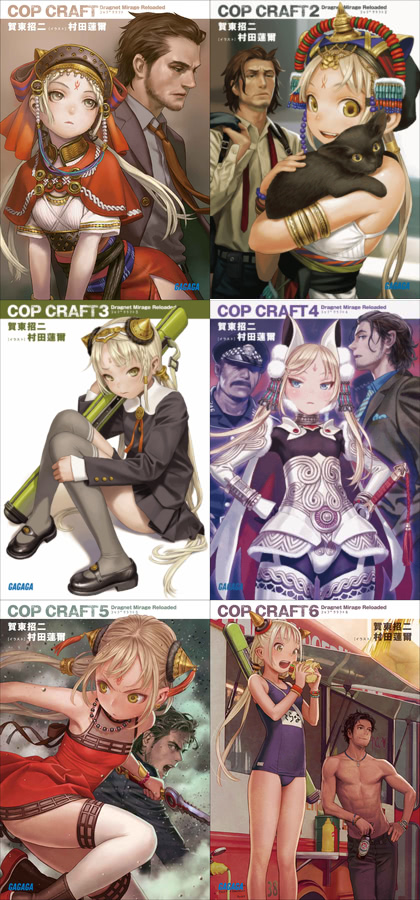
I bought the Kindle edition of the novels on Amazon Japan, grabbed the
latest version of DeDRM and KindleUnpack, and dusted off my
Yomitori scripts (last updated
in 2013…) to extract the pictures and make the text easier to read. To
my surprise, the scripts mostly still worked, except for the one that
uses dviasm.py to optimize the furigana, a tool that no longer
handles uplatex output correctly (looks like I’ll have to switch to
dv2dt/dt2dv to molest DVI files now).
After the jump, the magic words are: “She’s 26 In Elf Years!”
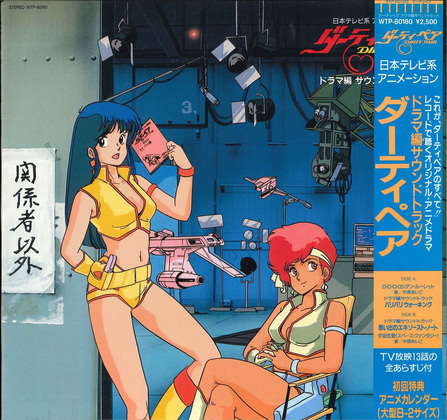
Dear Amazon,
Please stop putting things in the “New Releases” recommendation list three months before they’re released. This has been showing up on my lists for weeks, and not only does the Kindle edition not come out until September, the paperback edition doesn’t come out until December.
Pixiv: R-18
The Pixiv tag “R-18” means different things to different artists. For some, it’s equivalent to “NSFW”, but for many, it’s closer to “includes censored penetration”, and quite often “my mother would kick me out of the basement if she knew I fantasized about this”, with anything not quite as raw left open for all to see.
Gratuitous Mahoro to make it clear that this set has work-safety issues:

[amusing note: Google image search thinks this Mahoro image is related to the Mongolian Society of Interventional Radiology]
Cop Craft
He’s a jaded chain-smoking detective out to avenge his partner.
She’s a loli knight elf with a chip on her shoulder.
THEY FIGHT CRIME.
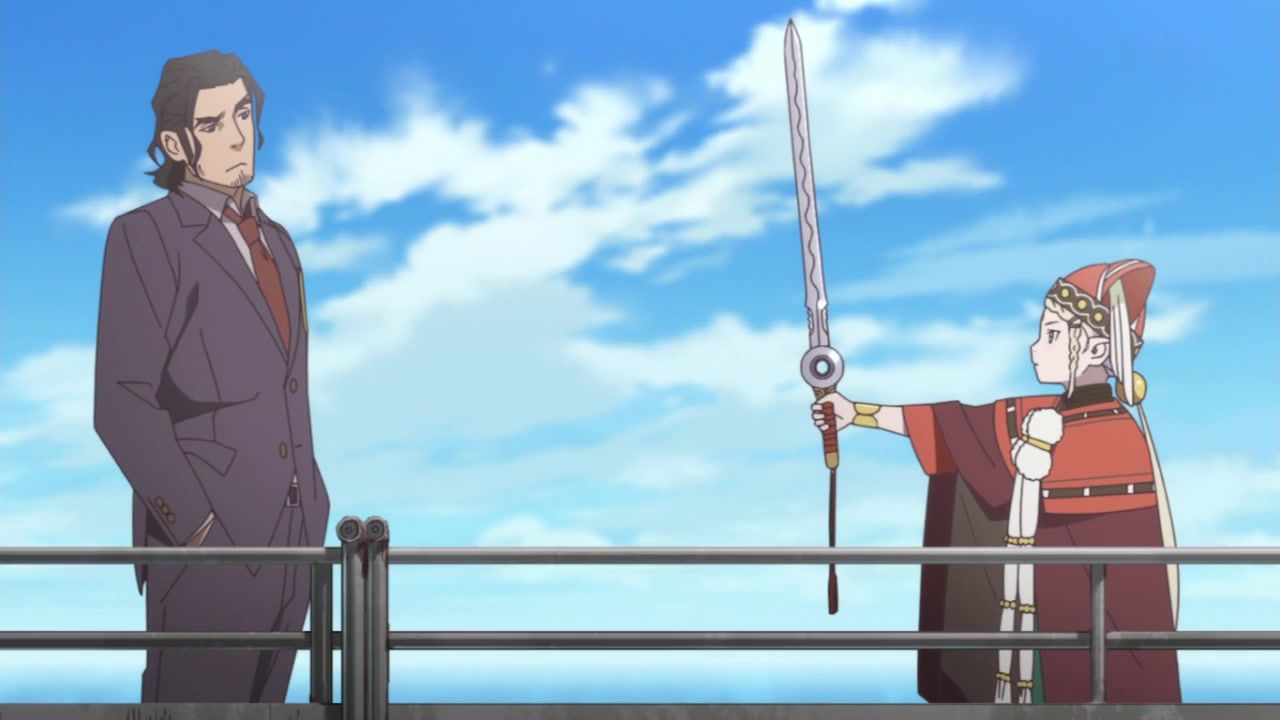
From the author of FullMetal Panic! and Amagi Brilliant Park, with character designs by Range Murata (who also illustrated the light novels). The first two episodes were better than I expected, so I watched the third as soon as it was released on Funimation. There’s nothing terribly new here if you’ve heard of Alien Nation or Bright, but so far the execution looks solid, if a bit rushed. I doubt it will get as lively as the OP animation, however.
They’ve got 6 light novels of source material to work with for 12 episodes, so they shouldn’t run out. Just in case, though, the credits promise loli-elf-service, and episode 3 delivers a bit of it. Caveat: there are some gaps in the storytelling that feel like they were a little too focused on making sure they only spend four episodes per book.
On that note, it looks like book 7 is timed for mid-season, after a three-year hiatus.
Short clip after the jump.
The Respun Marches
As vaguely promised, here’s what happens when I take the sector data for The Spinward Marches and run it through my scripts to create a completely new sector.
But first, a slight tweak: the Importance stat I mentioned ranges from
-3 to 5, which is sufficient for my basic goal of separating the wheat
from the chaff, but I decided it doesn’t have enough granularity to
truly spread the best systems around the sector, so I multiplied it
by another derived stat, Resource Units (“stuff to grab”), which
ranges from rather negative to quite positive. Avoiding zeroes for
both, the exact scoring method used was: ($ix + 4) * ($ru||1)
(yes, the Importance stat is called “ix”, or more precisely {Ix},
because Marc Miller apparently has an affection for chartjunk; there’s
also an (Ex), and a [Cx], and if he ever writes another version of
Traveller, I imagine it will have
Now, let’s respin The Spinward Marches, with data and PDFs courtesy of The Traveller Map!
#AccidentalParodyAccount
The Writer Beware blog is an excellent resource for learning about the many con artists and general scum preying on would-be authors. Sometimes, however, there’s unintended comedy (emphasis mine):
There’s some disagreement over whether there actually is such a thing as a hybrid publisher–a company that charges substantial fees yet provides a service that’s otherwise equivalent to traditional publishing, including rigorous selectivity and editing, high royalties, offline distribution, non-bogus PR, and more.
Perhaps they should post a list of precisely which traditional publishers qualify under these guidelines, which are widely reported to be more often promised than delivered…